
LaTeX to Word
Share a LaTeX paper with people who use Word — equations, references and figures included.
Drop files or a folder
.md · .docx · .tex · .pdf · .zip — include images and refs.bib
The PDF is re-typeset in the style you choose — headings, lists, tables, pictures and text colors are kept.
If ticked, this PDF is sent to SoMark's free recognition service (free-oxr.somark.ai); this usually takes 30–90 seconds. Unticked, it stays on this site. Privacy
Public repositories. Paste the address of a .md file, a folder or a repository (its README is used). Pictures the file uses are fetched too.
Optional. Follows its page setup, fonts and styles, its headers and footers as in Word (odd / even and first pages, tables, logos, watermark) and page numbers. A cover or letterhead in it is used too: mark the values with {{title}}, {{date}}… and the place of your text with {{body}}.
More options
Done
The conversion didn't finish
Write Markdown. Get documents that look professionally typeset.
Every page below was typeset by this converter straight from the source beside it — systems of equations, matrices, multi-level merged headers, dashboards, theorem boxes, citations. Nothing retouched.
---
title: Attention-Weighted Physics-Informed Neural Networks for the Unsteady Navier–Stokes Equations
author: Ming Wang^1^, Hua Li^1,2^, Siyuan Chen^2^
date: September 2026
abstract: Physics-informed neural networks (PINNs) often fail to converge on unsteady flows at high Reynolds numbers because the gradients of their loss terms are badly out of balance. We propose Attn-PINN, which uses an attention mechanism to weight the residuals adaptively, and prove an upper bound on its approximation error. For flow past a cylinder ($\mathrm{Re}=3\,900$), Attn-PINN reaches a relative $L^2$ error of $1.7\times10^{-3}$ — **an order of magnitude** below the baseline — while training 41% faster.
bibliography: refs.bib
number-sections: true
header-left: Attn-PINN for the Unsteady Navier–Stokes Equations
---

# Introduction

PINNs embed the residual of a partial differential equation in the loss of a neural network [@raissi2019]. They need no mesh and solve forward and inverse problems alike, and have become a core method of scientific machine learning [@karniadakis2021]. For the strongly nonlinear Navier–Stokes equations, however, the gradients of the individual loss terms can differ by more than $10^{3}$, trapping training in a “gradient pathology” [@wang2021]. Neural operators [@li2021] ease the problem but need large amounts of labelled data. Borrowing the attention mechanism of the Transformer [@vaswani2017], we let the network **learn** the weight of every collocation point during training.

# Problem statement {#sec:problem}

Consider incompressible viscous flow in a domain $\Omega\subset\mathbb{R}^2$. The velocity $\mathbf{u}=(u,v)^{\top}$ and pressure $p$ satisfy

$$
\left\{
\begin{aligned}
\frac{\partial \mathbf{u}}{\partial t} + (\mathbf{u}\cdot\nabla)\mathbf{u}
  &= -\frac{1}{\rho}\nabla p + \nu\,\nabla^{2}\mathbf{u} + \mathbf{f},
  && (\mathbf{x},t)\in\Omega\times(0,T],\\
\nabla\cdot\mathbf{u} &= 0,
  && (\mathbf{x},t)\in\Omega\times(0,T],\\
\mathbf{u}(\mathbf{x},0) &= \mathbf{u}_0(\mathbf{x}),
  && \mathbf{x}\in\Omega,
\end{aligned}
\right.
$$ {#eq:ns}

where $\nu$ is the kinematic viscosity. With networks $\hat{\mathbf{u}}_{\theta}$ and $\hat{p}_{\theta}$ approximating the solution, the momentum residual is
$\mathbf{r}_{\theta} = \partial_t\hat{\mathbf{u}}_{\theta} + (\hat{\mathbf{u}}_{\theta}\cdot\nabla)\hat{\mathbf{u}}_{\theta} + \rho^{-1}\nabla\hat{p}_{\theta} - \nu\nabla^{2}\hat{\mathbf{u}}_{\theta} - \mathbf{f}$.

# Method {#sec:method}

## Attention-weighted residuals

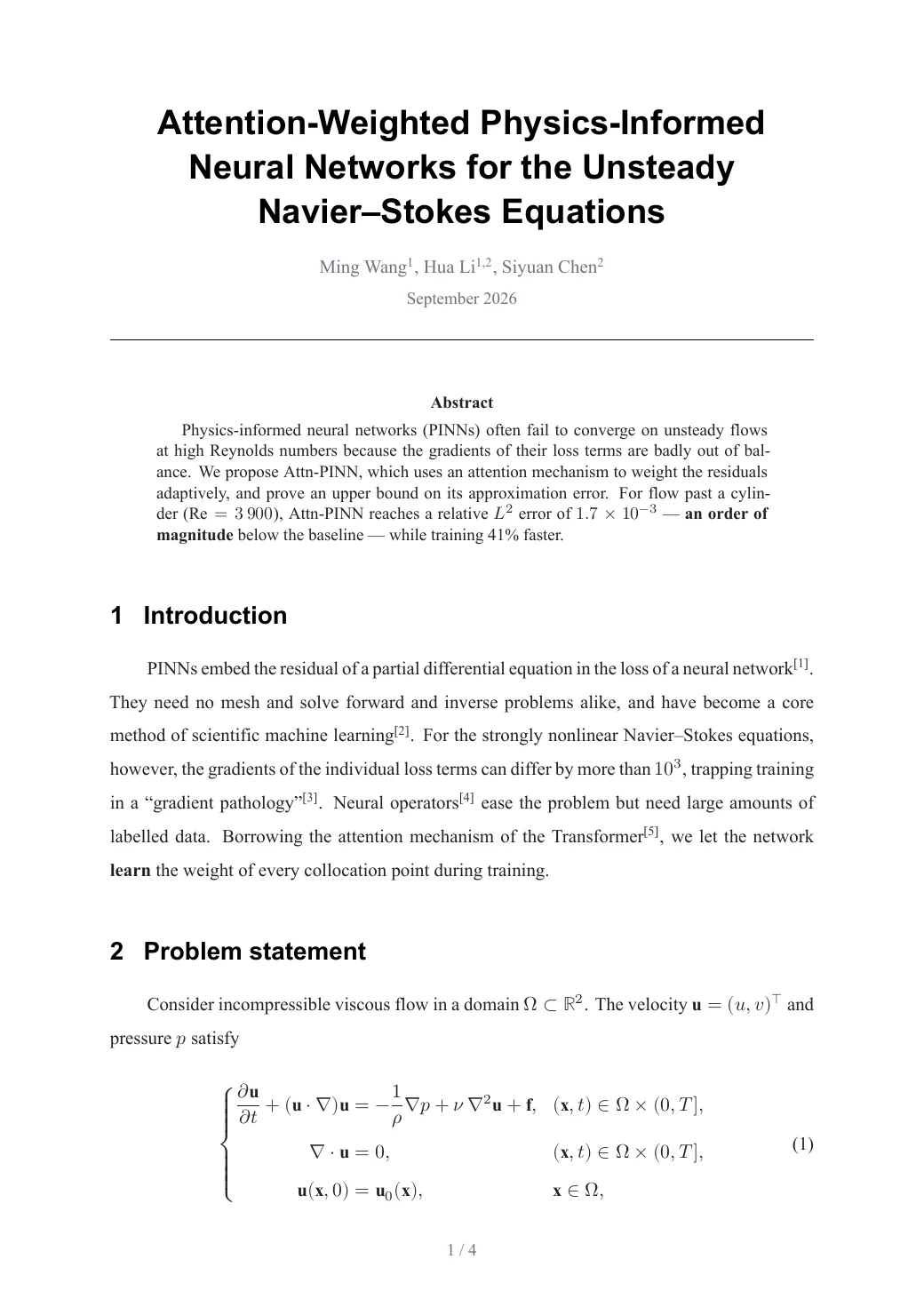
For $N_r$ collocation points $\{\mathbf{x}_i\}$, the weights come from scaled dot-product attention over residual features:
…
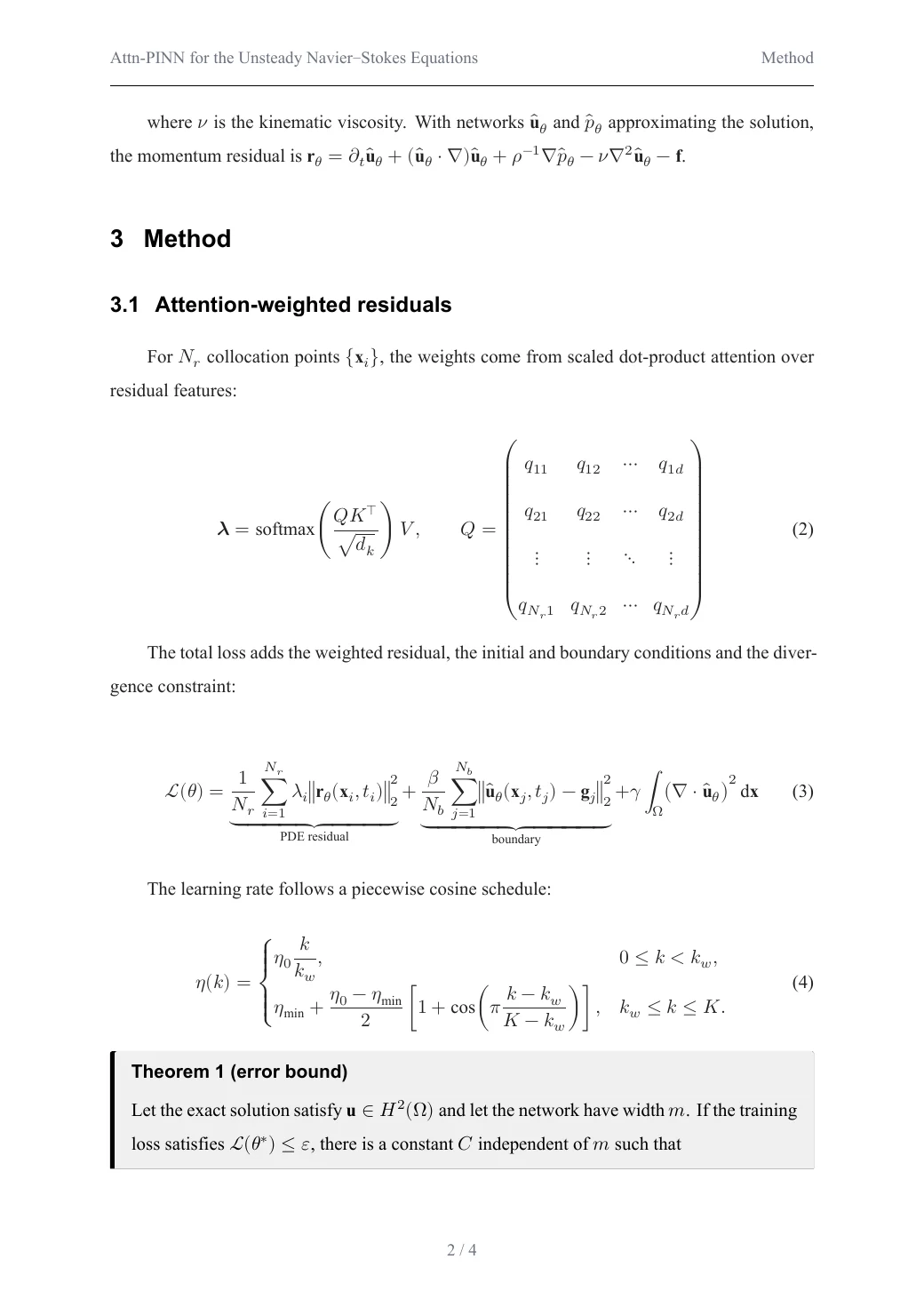
The Navier–Stokes system, matrices, piecewise functions, an annotated loss with underbraces, a theorem box, subfigures and a .bib bibliography — numbered and cross-referenced automatically.
Open this PDF ↗Also delivered as an editable Word file
Browse all examples, with PDF, Word and source to download →
Equations stay equations
Inline and display math become editable Word equations, with their numbers.
Cross-references resolved
References to sections, figures, tables and equations become readable numbers and links.
Bibliography
Citations from your .bib file are formatted as a numbered reference list.
Your formatting
Text colors, font sizes and fonts set in the source are carried over where Word allows.
How it works
- 1
Upload the project
Drop the folder or a .zip with the main .tex file, the files it includes, the figures and the .bib.
- 2
Check the main file
The file with \documentclass is picked automatically; you can choose another.
- 3
Download
Get an editable .docx, a PDF in the chosen style, and the content as Markdown.
Questions and answers
Are TikZ drawings supported?
Not on the online service: TikZ pictures are replaced by a placeholder. Export them as images (PDF or PNG) and include those instead.
Are multi-line equations numbered per line?
An align block gets one number for the whole block; the notes after conversion point this out.
Which bibliography style is used?
References are formatted in the GB/T 7714 numeric style.
Can the PDF keep my original LaTeX layout?
On the online service the PDF uses the style you choose. The original layout is only available when running md-to-pdf-word on your own computer.